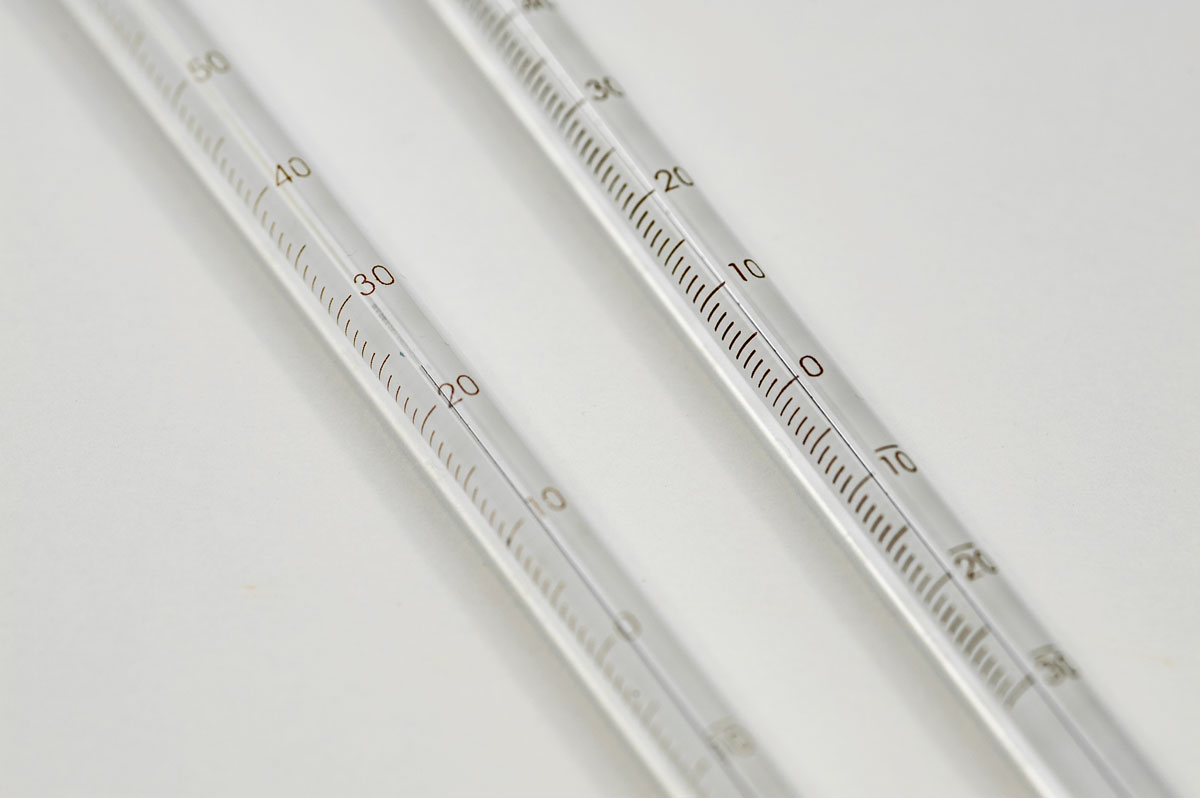
- Liquid-in-Glass Thermometers
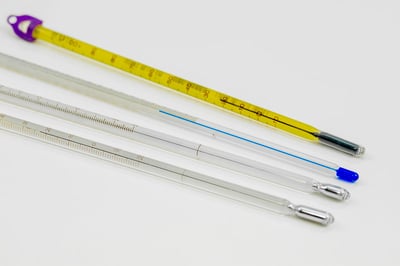
Definition: Classic thermometers that use mercury or dyed alcohol sealed in a glass tube.
How It Works: The liquid expands with heat and rises against a calibrated scale.
Used In: Labs, calibration rooms, and field checks where no electronics are allowed.
Notes: Don’t underestimate these—still considered a calibration reference in many labs. Fragile but timeless.
References:
- ASTM E1 – Standard Specification for ASTM Liquid-in-Glass Thermometers
- ISO 1770 – Solid-stem general-purpose thermometers
- ASTM E563 – Standard Practice for Preparation and Use of an Ice-Point Bath as a Reference Temperature
- Bimetallic Thermometers
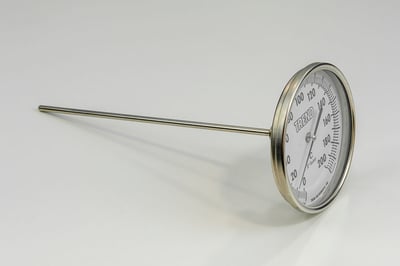
Definition: Mechanical thermometers using two bonded metal strips with different expansion rates.
How It Works: Temperature causes the strip to bend, turning a needle on a dial.
Used In: HVAC, ovens, tanks—places where ruggedness wins over precision.
Notes: Tough but crude. Good for rough monitoring, not data collection.
References:
- ASME B40.200 – Pressure and Temperature Instruments
- ISO 13163 – Bimetallic strip thermometers — Construction and accuracy classes
- Thermocouples
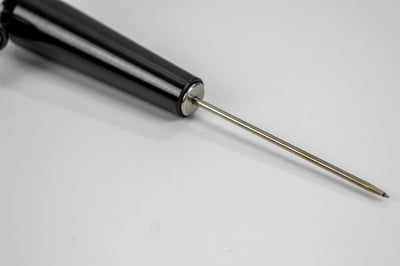
Definition: Sensors made by joining two dissimilar metals that generate a voltage proportional to temperature.
How It Works: The Seebeck effect produces a tiny voltage that changes with temperature.
Used In: Kilns, engines, industrial curing ovens—anywhere you need fast response and wide ranges.
Notes: Available in different “Types” (J, K, T, N, etc.), each with a specific range and stability profile. Calibration is key.
References:
- ASTM E230/E230M – Temperature-EMF Tables for Standardized Thermocouples
- IEC 60584 – Thermocouples — EMF Specifications and Tolerances
- Resistance Temperature Detectors (RTDs) / Industrial Platinum Resistance Thermometers (IPRTs)
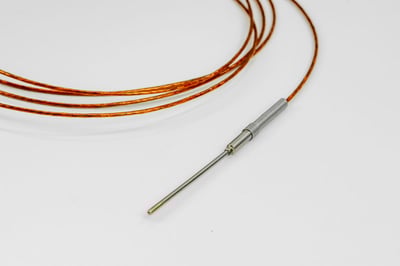
Definition: Temperature sensors whose resistance increases with temperature—commonly made of platinum.
How It Works: Typically uses a 100-ohm platinum element (Pt100). Resistance is read via a Wheatstone bridge or digital circuit.
Used In: Lab environments, process control, quality-critical measurement systems.
Notes: Accurate, stable, and more linear than thermocouples, but generally more fragile and expensive.
References:
- ASTM E1137/E1137M – Industrial Platinum Resistance Thermometers
- IEC 60751 – Industrial platinum resistance thermometers and sensors
- Platinum Resistance Thermometers (PRTs)
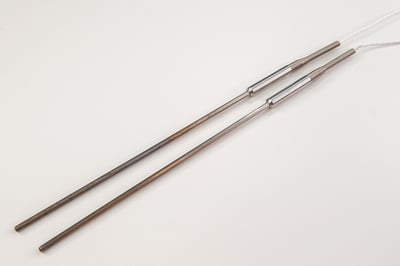
Definition: A category of RTDs that use platinum as the sensing material—offering high accuracy and chemical stability.
How It Works: Same principle as RTDs; PRTs are often built with high-purity platinum and better thermal contact structures.
Used In: Industrial process monitoring, environmental chambers, precision thermal control in rubber testing systems.
Notes: The reliable, workhorse RTDs—less extreme than SPRTs, but more refined than budget RTDs.
References:
- IEC 60751 – Platinum resistance thermometers
- ASTM E2877 – Digital Contact Thermometers
- Standard Platinum Resistance Thermometers (SPRTs)
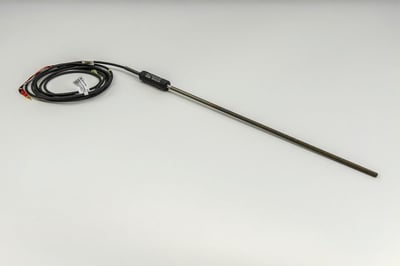
Definition: The most accurate class of thermometers used to define and calibrate temperature standards.
How It Works: Uses ultra-pure platinum wire in a carefully constructed housing, usually read by precision bridge circuits.
Used In: National metrology labs, accredited calibration services, reference-grade measurements from -200 °C to 960 °C.
Notes: These are the gold (well, platinum) standard—SPRTs are used to realize the International Temperature Scale (ITS-90).
References:
- ASTM E1139 – Standard Specification for Standard Platinum Resistance Thermometers (SPRTs)
- ITS-90 – International Temperature Scale of 1990
- Thermistors
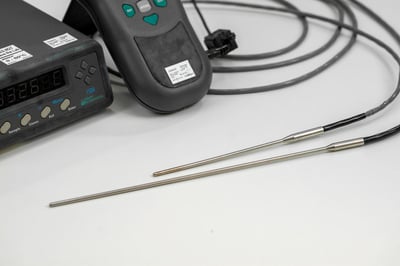
Definition: Sensors made from ceramic materials whose resistance changes rapidly with temperature.
How It Works: Typically negative temperature coefficient (NTC)—resistance decreases as temperature increases.
Used In: Digital thermometers, medical probes, climate control devices.
Notes: Fast and cheap, but nonlinear and narrow-ranged.
References:
- ASTM E2309 – Thermistor Sensors for General Temperature Measurement
- IEC 60531 – Thermistors for temperature measurement — Direct-immersion type
- Infrared (IR) Thermometers
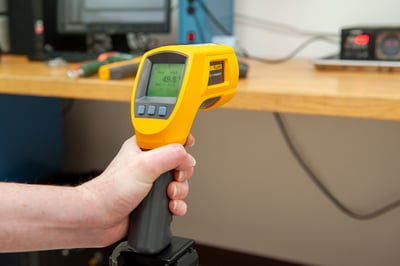
Definition: Non-contact thermometers that detect infrared radiation emitted by surfaces.
How It Works: A lens focuses IR energy onto a sensor, converting it into a temperature reading.
Used In: Food inspection, rotating equipment, open-flame applications, and quick surface checks.
Notes: Fast and safe, but sensitive to surface emissivity and environmental interference.
References:
- ASTM E2847 – Calibration and Use of Infrared Thermometers
- ISO 18434-1 – Thermography — General Procedures
- Digital Thermometers
Definition: Any thermometer that gives a digital output—usually based on thermistors, RTDs, or thermocouples.
How It Works: Measures sensor output and converts it into a number on a display.
Used In: General lab use, industrial settings, food safety, and medical applications.
Notes: The interface is digital, but the sensor inside matters. Don’t judge a thermometer by its screen alone.
References:
- ASTM E2877 – Digital Contact Thermometers
- ISO 80601-2-56 – Medical Electrical Equipment — Clinical Thermometers
Cost & Accuracy Comparison Table
|
Thermometer Type |
Typical Accuracy (±°C) |
Temperature Range (°C) |
Relative Cost (USD)* |
Response Time |
Typical Calibration Standard |
|
Liquid-in-Glass |
0.1 – 1.0 |
-80 to 400 |
$50–$300 |
Slow (30–60 s) |
ASTM E1, ISO 1770 |
|
Bimetallic |
1.0 – 3.0 |
-50 to 600 |
$30–$200 |
Moderate (10–30 s) |
ISO 13163 |
|
Thermocouple (Type K/J) |
0.5 – 2.0 |
-200 to 1700 |
$20–$300 |
Fast (<1 s) |
ASTM E230, IEC 60584 |
|
RTD / IPRT (Pt100) |
0.05 – 0.3 |
-200 to 600 |
$50–$400 |
Moderate (1–5 s) |
IEC 60751, ASTM E1137 |
|
PRT |
0.03 – 0.15 |
-200 to 660 |
$150–$700 |
Moderate |
IEC 60751, ISO 17025 |
|
SPRT |
0.001 – 0.01 |
-200 to 960 |
$2,000–$8,000 |
Slow |
ASTM E1139, ITS-90 |
|
Thermistor (NTC) |
0.05 – 0.2 |
-50 to 150 |
$10–$100 |
Fast (<1 s) |
ASTM E2309, IEC 60531 |
|
Infrared (IR) |
0.5 – 2.0 |
-50 to 3000 (surface) |
$50–$500 |
Instant (<0.5 s) |
ASTM E2847, ISO 18434 |
|
Digital (varies by sensor) |
0.1 – 1.0 |
Sensor-dependent |
$30–$300 |
Sensor-dependent |
ASTM E2877 |
*Approximate 2025 retail cost ranges for industrial or laboratory-grade units (USD).