Practices for Determining Calibration Intervals
Establishing Calibration Intervals
- Guidance Documents
The following references form the foundation for calibration interval decisions:
- ISO/IEC 17025:2017
- ILAC-G24:2022 / OIML D10:2022
- NCSLI RP-1:2019
- JCGM 100:2008 (GUM)
- Initial Determination of Calibration Intervals
Initial calibration intervals should be determined by considering:
- OEM Recommendations
- Required measurement uncertainty
- Type and drift behavior of the instrument
- Environmental and usage conditions
- Manufacturer recommendations
- Risk and impact of measurement error
- Operator training and process maturity
-
- Role of Measurement Uncertainty
As per GUM (JCGM 100:2008), uncertainty growth due to drift should not cause total uncertainty to exceed acceptable limits before recalibration. Calibration intervals must be shortened if drift contributes significantly to uncertainty between calibrations.
- Common Calibration Interval Models
Time-Based Intervals
Fixed intervals (for example, annual calibration) are acceptable only when supported by historical performance data. Time-based intervals are simple but must still be justified.
Usage-Based Intervals
Intervals based on cycles, hours, or number of measurements are appropriate when wear or drift correlates strongly with use. Examples include torque tools and mechanical gauges.
Condition-Based Intervals
Calibration is triggered by defined conditions such as environmental exposure, relocation, overload, or maintenance. This approach is effective when drift is event-driven rather than time-driven.
Performance-Based (Statistical) Intervals
Intervals are determined by ongoing performance monitoring. Calibration occurs when drift trends approach predefined limits. This is the most technically robust approach but requires disciplined data management.
- Documentation and Compliance
ISO/IEC 17025 requires justification and documentation of calibration intervals, including:
- Historical data
- Risk assessments
- Uncertainty budgets
- Review records
This documentation supports audit readiness and technical accountability.
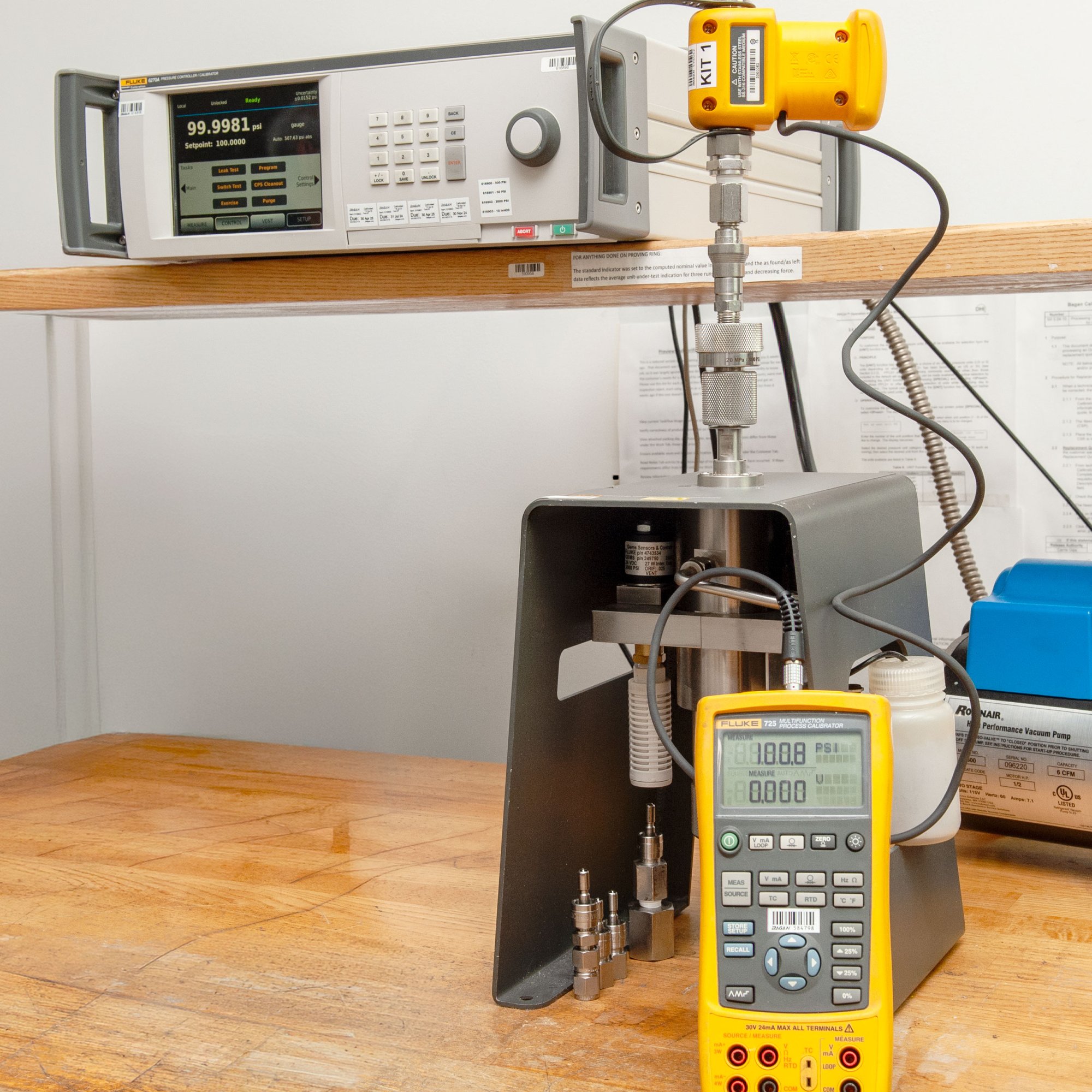
- Example Application: Digital Pressure Gauge
Instrument: Digital pressure gauge (0–10,000 psi)
Application: In-process pressure verification
Requirement: ±0.05% of readingFindings: Over four calibration cycles, drift increased gradually, leading to a failed calibration at 12 months.
Decision: Using the control chart and staircase methods (ILAC-G24 §6.2, §6.3), the interval was reduced to 9 months.
Result: No further failures observed in subsequent cycles; interval change was documented and justified based on risk and uncertainty analysis.
Year
Calibration Result
Deviation from Nominal
Pass/Fail
Y1
9,998 psi
–2 psi
Pass
Y2
9,993 psi
–7 psi
Pass
Y3
9,991 psi
–9 psi
Pass
Y4
9,985 psi
–15 psi
Fail
- Conclusion
Calibration interval determination is a dynamic, evidence-based process integral to laboratory quality systems. International standards encourage laboratories to go beyond fixed schedules by implementing methodologies that reflect:
- Actual equipment performance
- Measurement uncertainty contributions
- Operational and environmental risks
A combination of statistical tools, risk models, and sound metrological judgment allows organizations to strike an optimal balance between measurement confidence and operational efficiency.
About Richard J. Bagan, Inc.
Richard J. Bagan, Inc. is an ISO/IEC 17025–accredited calibration laboratory specializing in dimensional, force, torque, and materials testing instrumentation. Our metrology services support manufacturers, laboratories, and regulated industries across the United States.
For gage block calibration, uncertainty evaluation, or consultation on dimensional standards management, contact our laboratory team.
You Can Rely on Bagan Calibration Services
We pride ourselves on our premier customer service, which has allowed us to maintain relationships with customers since the beginning. Many of our customers range from Fortune 500 companies to privately owned specialty companies across the U.S.A and other countries. Our proprietary Management Information and Reporting System, BaganTrack gives you direct access to your customer service representative, certificates, master gauge list, and more. Additionally, BaganTrack is compliant to ISO 9001:2015. It is our goal to give you the best experience possible as your calibration and technical service provider.