
1. What is a Decision Rule?
According to ISO/IEC 17025:2017, a decision rule is:
"A rule that describes how measurement uncertainty is accounted for when stating conformity with a specified requirement" (Clause 3.7).
When reporting conformity, the laboratory must define and apply a decision rule that incorporates the risk of false accept (PFA) and false reject (PFR), unless it is already specified by the customer or standard.
2. Risk Considerations: PFA and PFR
- PFA (Probability of False Acceptance): The risk of accepting an item that is actually non-conforming.
- PFR (Probability of False Rejection): The risk of rejecting an item that is actually conforming.
Managing these risks is central to choosing or designing a decision rule. Standards like JCGM 106:2012 and ASME B89.7.4.1 offer statistical models to quantify and control these probabilities based on uncertainty and guard bands.
3. Types of Decision Rules
Below is a summary of commonly used decision rules and their impact on measurement risk.
a. Simple Acceptance (Shared Risk)
- Accept result if within tolerance limit, without guard band.
- Risk: PFA ≈ 50% at limit.
- Application: Only acceptable when the risk is shared explicitly with the customer.
b. Guard Banding (Consumer Risk-Based)
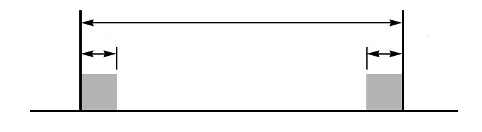
- The acceptance zone is narrower than the tolerance by applying a guard band.
- Conformance is declared only if the result lies within the guard band.
- Preferred method to control risk, regardless of the measurand.
- Controls: PFA to target values (e.g., 2%, 10%).
- References: ASME B89.7.4.1, JCGM 106, ILAC G8.
c. Conditional Decision Rules
- Define an acceptance zone, rejection zone, and a transition zone.
- Decisions in the transition zone may trigger further investigation.
- Balanced control of both PFA and PFR.
4. Guard Banding : Explanation
Guard Banding in Metrological Decision Rules
Guard banding is a risk mitigation strategy used in conformity assessment to reduce the likelihood of incorrect decisions caused by measurement uncertainty. It involves deliberately reducing the acceptance limits so that measurement results near the specification boundaries are subject to additional scrutiny or rejection.
In accordance with ISO/IEC 17025:2017, laboratories must define and document how measurement uncertainty is considered in conformity decisions (Clause 7.8.6.1). Guard banding is one of the most widely accepted methods to meet this requirement.
How Guard Banding Works
When specifications (e.g., upper and lower tolerance limits) are provided by the customer, guard bands are applied inward from those limits. The size of the guard band is determined by:
- The estimated measurement uncertainty (typically expanded uncertainty)
- The desired confidence level (e.g., 95%)
- The acceptable risk of false acceptance or false rejection
As a result, a guard banded acceptance zone is defined where measurement results can be confidently declared in tolerance, while results within the guard band zone may require conditional reporting or rejection.
5. Conditional Decision Rules: Explanation
-
- In metrology, conditional decision rules are applied when the measurement result lies close to the specification limits and the measurement uncertainty (U) introduces ambiguity into the conformity decision.
- Unlike binary rules—which only allow for Pass or Fail outcomes—conditional rules introduce intermediate categories, such as Conditional Pass and Conditional Fail, to recognize and manage decision risk. These rules are particularly useful when:
- The measurement result is inside the tolerance, but the uncertainty extends beyond the specification limits (Conditional Pass).
- The measurement result is outside the tolerance, but the uncertainty range overlaps the specification (Conditional Fail).
- These cases do not provide sufficient confidence to make a definitive conformity statement. As a result, further review, risk analysis, or customer communication may be necessary before taking action.
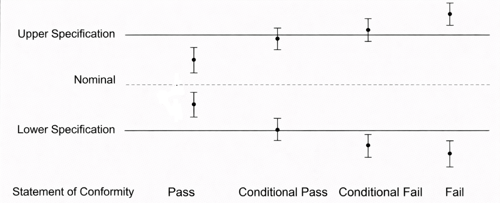
- Pass
- The measured value and its entire uncertainty range are well within specification limits.
- Conformance is declared without reservation.
- Conditional Pass
- The measured value is within specification, but uncertainty extends outside.
- There is a risk of false acceptance (PFA).
- Decision requires review or may depend on risk tolerance.
- Conditional Fail
- The measured value is outside the specification, but uncertainty overlaps with tolerance.
- There is a risk of false rejection (PFR).
- May require additional information or repeat testing.
- Fail
- The measured value and uncertainty range are entirely outside specification.
- Nonconformance is confirmed with high confidence.
6. Decision Rule Selection and ISO/IEC 17025 Requirements
ISO/IEC 17025:2017 requires the decision rule to be:
- Documented
- Agreed upon with the customer
- Appropriately justified, including consideration of risk levels.
JCGM 106:2012 and ISO Guide 98-4 offer advanced methodologies to evaluate risk and implement suitable rules based on customer specifications and uncertainty budgets.
Key Takeaways for Quality Managers
Measurement uncertainty is not optional—it’s a core metrological requirement and a foundation for conformity assessments.
Decision rules translate uncertainties into decisions. Without them, conformity statements lack metrological justification.
ISO/IEC 17025 demands transparency: Your lab must define, document, and communicate decision rules before issuing any conformity statements.
Choose rules based on risk: Simple acceptance may be suitable for low-risk work, but guard-band or probability-based rules are often safer and more defensible.
Final Thought
In modern metrology, a measurement is more than a number. It is a decision input with quantified uncertainty, requiring a formal rule to interpret it responsibly. Decision rules are the mechanism that bridges metrological rigor with real-world conformity decisions—and mastering them is essential for any laboratory committed to quality, compliance, and scientific integrity.